Wednesday, 8 July 2015

7th July 2005


Today was the anniversary of the London bombings - three on the Underground and one on a route 30 bus.

This anniversary is recognised annually but on this tenth occasion there were simultaneous marks of respect at each of the sites, as well as at the permanent memorial in Hyde Park and a service of thanksgiving at St Paul’s Cathedral.

Survivors, families, colleagues and friends were joined by passers-by at each of the locations.

Whilst Commissioner of Transport Sir Peter Hendy accompanied the Prime Minister and Metropolitan Police Commissioner at Hyde Park, London Underground Managing Director Mike Brown attended Kings Cross.

For my part I went to Tavistock Square - the site of the explosion that killed 13 people on a route 30 bus which was on diversion due to the earlier incidents. The bomb detonated outside the British Medical Association who were also represented today along with the gallant and brave members of TfL staff, the emergency services, and the public, putting themselves at risk if further devices were to go off. 

With me was George Psarakadis (pictured) - the Stagecoach bus driver of that 30 bus.  He steadfastly continues to drive London’s bus passengers but today we walked, side-by-side to place the wreaths at the Tavistock Square memorial site.

Later we went to St Paul’s Cathedral for a memorable and moving service of remembrance. All of the faiths were represented and the service was attended by the Prime Minister, past and present Mayors, Ministers and members of the London Assembly. With us all were the families and survivors of that terrible day.

Uplifted by the music, words and prayers of the service we left the main entrance of St Paul’s to London going about its business as usual. As it did immediately after those terrible events of ten years ago.

...

Sunday, 14 June 2015

Donald Allmey

Former London coach operator Don Allmey, who founded and ran Allmey Coaches of Eastcote, died on 6th June aged 78.

Don was more than just a family coach operator which were typical in London and elsewhere in the post-war years. Both Don and his wife Jean were well-known to their loyal customers for very many years and their fleet a familiar sight.

Don and his late brother Allan, had a special interest in old London buses. In the 1960s, they formed together with Prince Marshall of Old Motor Magazine, the London Bus Preservation Group. In the early 1970s they broke new ground by securing a former Vickers building in Weybridge and created the first undercover private museum for London buses. The collections of vibrant and working London buses through the years owned by private individuals, owes a tremendous amount to their foresight and courage often at huge personal risk given the guarantees and commitments required.

That museum now lives on in a different location, inside Brooklands Museum. It is open to the public daily - an extraordinary achievement inconceivable in those early days.

Allan and his wife Lyn were tragically killed in a car accident in 1978. Don and Jean brought up their young nephew William, together with their own children: Victoria is married to Des Maybury, Director of the Big Bus Tours empire, whilst in another twist of genealogy, son Martin works in vintage vehicle restoration with Prince's son Sebastian.

An old fashioned entrepreneur (although he would have considered that a posh word for 'wheeler dealer'), Don ran a successful business selling spares, parts and vehicles. His encyclopaedic knowledge of AEC products and their workings made him always in demand.

Don belonged to a special era when deals were done on personal knowledge and trust, and his eye for business was as acute as his kindness and genuine desire to help others.

He and Jean retired to Cyprus. However, after his onset of dementia, they returned to England. For some years now Don had been in full-time care. As is often the case, recollections of some wonderful days in the past would reawaken his otherwise declining awareness, always bringing a smile to his face.

The funeral is on 22nd June.

Sunday, 2 November 2014

"Take a number 11...."


Our Year of the Bus celebration is coming to a close. After an extraordinary year we are undertaking the last few events. 

A couple of weeks ago the Bus Sculptures were unveiled across London and today nearly 20 heritage RT family buses from the 1940s and 50s joined together in a celebration operation along route 11.

Retracing its route of the time, the buses ran from Liverpool Street Station (still the present terminus) through the heart of the City and West End to Chelsea and then on to Hammersmith and Shepherds Bush.

Rides were free and thousands of ordinary passengers were surprised and delighted when a bus some 60 or 70 years old arrived to take them on their journey. Passengers received commemorative tickets and the buses ran mostly full all day. Early rain did not dampen spirits and by the afternoon the weather was fine and dry.

The onset of dusk reawakened memories of over half a century ago as the yellowish glow of light bulbs heralded the arrival of the buses as they criss-crossed London amongst the flashing theatre signs in London’s West End.

Importantly the young – for whom this is not a memory but a story told by adults – were fascinated to see urban public transport as it was over fifty years ago. The buses themselves kept pace with London’s much changed traffic conditions which is a testament to British engineering from the post-war period.

Buses were supplied by private owners, supporting companies and individuals notably Ensign Bus and London Bus Company. The event was organised by London Bus Museum at Brooklands, who also provided the oldest RT family bus itself, prototype RT1.

For my part, I was delighted to be offered the chance to drive RT3232 (which once pounded the streets between Brentwood and Aldgate as a Green Line coach) and later RTW75, whose owner, Roger Wright stopped for me outside Peter Jones at Sloane Square. What the passengers made of apparently letting a random member of the public take over the driving we do not know. A brisk run at dusk through the West End brought back many happy memories from a long time ago.

The buses went home and the passengers vanished into the night. Some passengers only just noticing – but the majority enjoying a surprise trip back in time as they went about their business in London. 


....

Monday, 29 September 2014

Tube train returns to Ongar branch after 20 years


Twenty years ago London Transport ‘pulled the plug’ on the Epping-Ongar branch of the Central line.

The story however started in 1865 when the Great Eastern Railway reached the Essex outpost of Epping. In 1950, driven by post-war housing demands, it became a fully-fledged part of the Underground.

London Transport became part of the Greater London Council during the political changes of 1970, which highlighted losses incurred on this line. There were several proposals for closure and indeed occasional interventions to promote usage. When it became impossible for the branch to justify the modernisation needed, the third closure proposal was successful and services ended on 30th September 1994.

The story does not end there. Ownership of the line is complicated by property aspirations and inherent obligations to provide some commuter services. Thus following a change in ownership in 2007 and significant investment, operations resumed in 2012 using miscellaneous stock.

After initial investigations in 2013, the last tube train from 1994, now owned by Craven Heritage Trains, was propelled onto the branch by diesel locomotives twenty years since its demise.  

A busy weekend of activities started on Friday morning when MD London Underground Mike Brown rededicated the long-standing milepost at Ongar Station. All mileposts on the Underground take their reference from here.


During the weekend 26-28th September the Craven unit was pushed and pulled between North Weald and Ongar. 

Video: Craven set leaves Ongar after 20 years

Steam locomotive Met 1, no stranger to the line, also pulled passenger coaches in service.

Throughout the weekend, visitors were able to enjoy a variety of bus services using interesting vehicles operated from Epping to Shenfield via North Weald and Ongar.

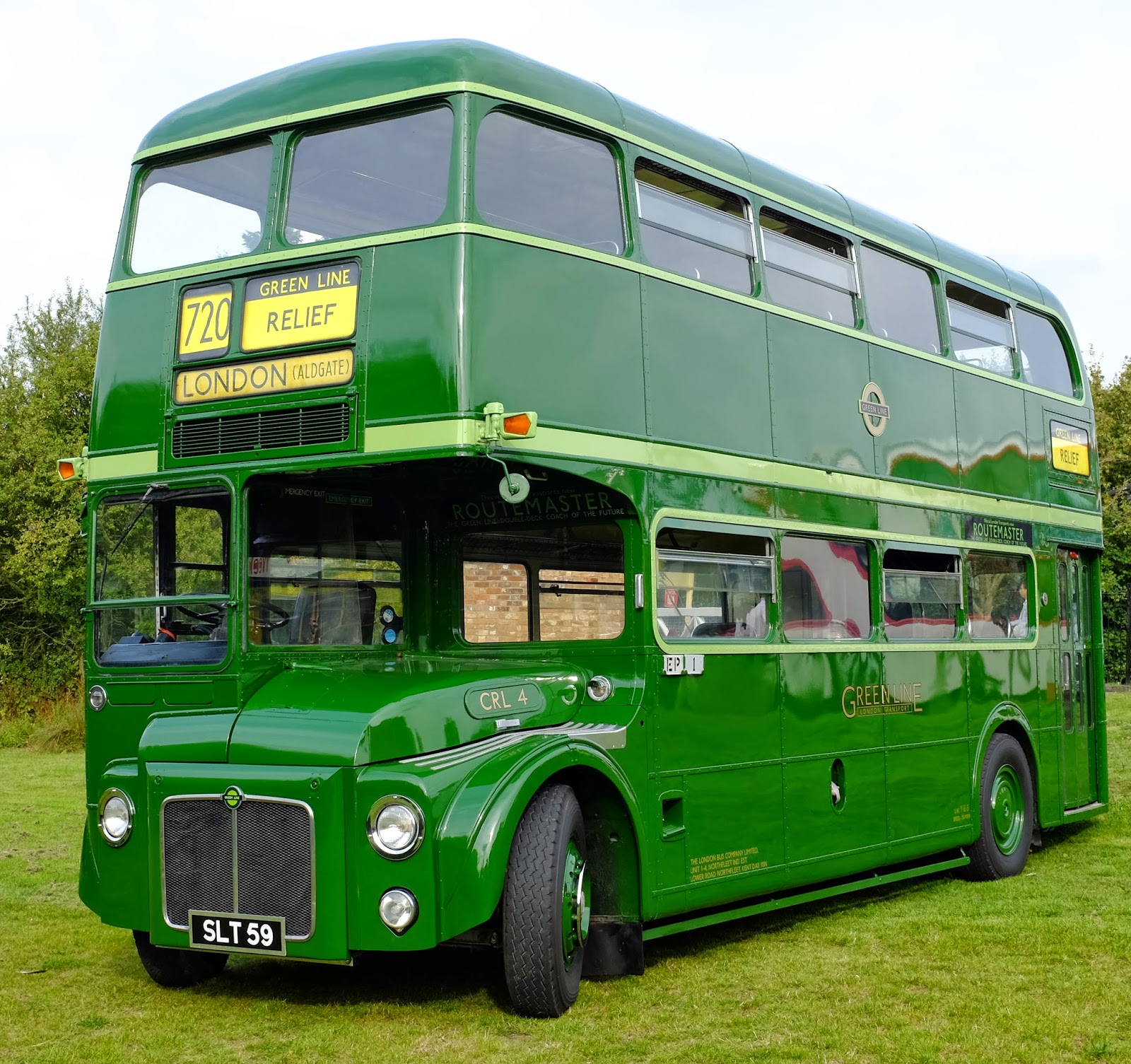
CRL4 now looking as new all those years ago
On Sunday the very first prototype Routemaster coach was unveiled. Now superbly restored with its original design front end and quirky interior layout. For the first time in several decades all four Routemaster prototypes were displayed together – three of them now looking much as they did in 1957-8.

With so much nostalgia around us, it was not surprising that there were happy crowds – from passionate enthusiasts to smiling children.

Twenty years ago the prospect of crowds on a railway which was lucky to carry 100 people a day seemed very remote.

Yet on a sunny Sunday in 2014 it was all there to see.


Updates often on Twitter at @LeonDaniels

....

Sunday, 6 July 2014

London Pride

Last Saturday we were celebrating Pride London with many thousands marching through the West End. Nothing was going to dampen spirits, not even the rain.

The first march took place 40 years ago, and over the decades it has become more of a carnival and less of a protest. For many years, the festival at the end of the march was held on Clapham Common or Finsbury Park. Nowadays it finishes in Trafalgar Square.

The Pride London event, supported by the Mayor, Boris Johnson, is currently organised by LGBT+ Community Pride who have a five year contract.

A dramatic new feature this year was a ‘rainbow crossing’ which replaced the usual one in Pall Mall East for the day. It was expertly laid down by our contractors and christened by Mike Freer MP, Stephen Gre
enhalgh, the Mayor’s Deputy Mayor for Policing and Crime, and TfL’s Martyn Loukes, Steve Allen and me. 

After we had posed for our ‘Abbey Road’ style photographs the crossing was declared open and it quickly became a huge attraction as everyone jostled to have their photo taken!


We then headed to Baker Street where the carnival was lining up. Numerous vehicles and floats from very many agencies and supporters were gathering together, notwithstanding the bursts of torrential rain.

Close to the very front of the parade was TfL’s own open top bus with Trevor Wright in charge and home to the TfL LGBT contingent. Ignoring the rain, the carnival moved off at 1pm and headed along Oxford Street, Regent Street, Lower Regent Street to Trafalgar Square. There were extraordinary crowds cheering along the entire route.

Such was the rain that our open top bus shipped huge quantities of water which eventually drenched poor Trevor and took out a number of the bus’ systems. Luckily the gear selection was unaffected so we kept moving but various other features (like doors, wipers and lights) took on a mind of their own. 

Aboard the bus numerous TV and radio interviews took place and the team took it in turns to march in front and around the bus passing out flyers and stickers to anyone and everyone.

And what about the rainbow crossing? 

Well of course, since it is NOT approved in the Traffic Signs and General Directions Regulations it had to be removed before general traffic returned. But the good news is that it was thoroughly cleaned and now resides at the Reception desk at TfL’s operational HQ at Palestra. Once again people are clamouring to have their photos taken on it!

....

Monday, 30 June 2014

Looking back down Regent Street

A week on from last Sunday’s Regent Street Bus Cavalcade and we are still receiving enthusiastic tributes on the hugely successful day.

We have had the most amazing reaction. It seems some 400,000 people attended, which is more than double that predicted. Across the world, social media has reported the wonderful, family atmosphere as people wandered around and through the buses. Allowing people onto the buses and in the cab was clearly a great element to the success of the day.

A special thank you to all of the vehicle owners, for not only supporting the event, but also welcoming visitors on board their vehicles.

It wasn’t just the buses or the Lego bus stop that were busy. Emma Hignett is the voice you hear announcing all the stops on London’s Buses. Emma spent the day making personal announcements on people’s iPhones. Non-stop all day. So thousands of people now have their own personal Emma announcement.


But as at all such events, not everyone will be quite so enthusiastic and we had some internet chatter on certain aspects.

We spent a great deal of time working on the parking plan. Getting the vehicles in and out safely with no conflicting movements or awkward manoeuvres, and no delay on arrival was our biggest challenge.

We also had to contend with the median strip which occupies much of Regent Street.

We deliberately avoided ropes and no-go areas so people could go almost anywhere. Securing a licence for the event meant that numbers of vehicles was prescriptive, where they parked etc. ensuring emergency vehicle access at all times.

As to the choice of vehicles, quite simply it came down to what was available, what was mobile, what could be moved and when assembled would provide a colourful and interesting streetscape. Of course there were types not represented but the wish list was governed by the total number of vehicles allowed.

We are still collecting photographs, videos and stories from this amazing day. There have been many calls for a repeat. How and when this might be will have to be decided. For now though, we look back on a hugely successful event and again send a huge thank you to everyone who made it possible.

....

Tuesday, 24 June 2014

Year of the Bus Cavalcade

Photo thanks to Peter Zabek

Wasn't Sunday's Bus Cavalcade in London's Regent Street amazing! It was attended by tens of thousands of people in glorious sunny weather. Not just bus enthusiasts, as I heard one person comment, but many members of the public especially families - many taken by delighted surprise when they found vehicles and cabs were open for exploration. Queues built up for several of the vehicle types and lasted all day. You had to be there to appreciate the atmosphere.

We lined up 185 years of London bus history from the 1829 Horse Bus to the New Routemaster on the road closed for traffic for the occasion. In between were examples of London bus types as diverse as a 1952 BEA coach and a converted STL used latterly as a tree lopper.

Too late to be included in the official programme, two vehicles sold at auction the previous week from the collection of the late Michael Banfield (S454 and his Tilling-Stevens petrol-electric). A last minute casualty was Optare CityPacer OV2 which couldn’t be made ready in time.

Others made appearances after a long time in obscurity. Prototype Routemaster RM2 is back after a decade during which time a carefully hand-built replacement front end was created solely from photographs of how it looked when new in 1957. Not far away was the only rear-engined Routemaster FRM1 painted in its original 1967 colour scheme of red and flake grey with its original front end design.

There are numerous stories to be told about the event - including the planning and our work with our partner organisations to make it happen. A huge number of people gave up their time to bring the show together and spend not only their Sunday, but countless hours beforehand in preparation. Any list of thanks would never be definitive. But I shall try nonetheless.

The Cavalcade was only possible thanks to City of Westminster, Regent Street Association and The Crown Estates.

Over half of the vehicles came from the London Transport Museum, London Bus Museum and Ensignbus. The planning needed to get them there (especially the ones which don’t run under their own power) was extraordinary. Others came from individual owners as well as TfL's contracted bus companies.

From within TfL - Andy Barr, Simon Buxton and Jon Hodges directed the event; numerous people from Sam Mullins’ team at the LT Museum made it possible for so many vehicles to be present; Bob Bird arranged more vehicles from Acton than ever before. The team at London Bus Museum under the Chairmanship of Guy Marriott gave us all they could without emptying their own place at Brooklands. Peter, Ross and Steve Newman delivered eight of their collection including newly repainted T499 completed only that week.

Working away too were the volunteers, the people from TfL Marketing & Communications, the Museum Shop and numerous others.

A huge team effort by a great team. Thank you. As you can imagine, I loved every minute of it.

And we promise to do it again - perhaps sooner than the 35 years it has taken since we last did so!


Above: Peter Zabek


....

Friday, 13 June 2014

Battle bus


On Thursday morning I was delighted to launch our 'newest' bus. But unlike the fleet of New Routemasters currently joining the fleet, this 'new' bus is 100 years old.

In 1914, more than 1000 London buses carried soldiers to the Western front, some returning with the injured. Painted khaki and with the windows boarded up, their civilian drivers bravely drove them no faster than their top speed of 16mph to places far away from their traditional London streets.

Back to today, the B2737 has been completely restored thanks to the Heritage Lottery Fund and other donations. It is one of only four of its type in existence, originally running on route 9 from Mortlake garage.

This morning outside the London Transport Museum I cranked its starting handle, firing into life its petrol engine in front of the press and stakeholders. After photographs and interviews were done the bus was left on the Piazza to be enjoyed by visitors before heading off to its first event - the London Bus Awards.

It will compete a limited number of engagements in London this summer before being painted khaki - in public - in Central London. It will reprise its expedition to France and Belgium where it will attend numerous events connected with the 100th anniversary of World War I.

So for a short while the B2737 will be in its original red livery. Look out for it at the London Bus Cavalcade in Regent Street on 22 June.


...

Monday, 21 April 2014

Year of the Bus underway

The modern cars and cabs give away that this is not the 1950s!
Our 2014 Year of the Bus is well underway and we have enjoyed several special bus events so far including the old and the new. Last Saturday, Londoners and visitors alike were treated to a feast of 1950s nostalgia. Celebrating 75 years since the RT-type bus entered service on route 22, a whole fleet of them joined into that days' operation.

After running most of the day between Homerton and Piccadilly Circus, the fleet headed for Putney Common and then onto Brooklands where the London Bus Museum was hosting a major event.

That evening I was delighted to be speaking at the Museum’s dinner. How things had changed I reminded everyone: in the early days - the night before the traditional Spring curtain-raiser we would have a Chinese takeaway before a short sleep ahead of the arrival of visitors. These days our dinner in the Brooklands Clubhouse includes white tablecloths and wine.

This tells a particular story – the Museum coming of age. Now it is a proper and increasingly accredited museum accessing funding from numerous sources and telling an important story about bus transport inside a larger transport museum.

I reminded all present of the hard work and sacrifices made by the founders. Having given up their jobs and mortgaged their homes, they established a proper museum for London’s buses against all conventional wisdom. Now we have a place where the public pay to visit and enjoy the collection.

The Museum’s original prime mover, founder and Secretary Alan Allmey was tragically killed along with his wife in a 1978 car crash. His co-founder Prince Marshall died from complications after an illness in 1981. Those that followed have transformed their passion and interest into a professional Museum that has kept pace with the changing world.

I remember that era well and am proud to recount those early days. I am also in a very privileged position to be part of the future. And forward it is with Year of the Bus now well underway with many more events to come.

More silver LTs are joining the fleet to support
Year of the Bus activities. A simpler livery has been adopted.
More silver New Routemasters will soon be joining London's fleet as we move closer to our major event on 22nd June. A closed Regent Street will play host to a cavalcade of London buses from the horse bus to present day buses.

Year of the Bus is celebrating the hard work of London’s bus staff, our heritage, the technology and of course how the bus services are the life blood of our city getting over 6m people a day to work, to school, to shopping and everywhere else!

Have you seen the special bus stop signs and logos adorning the network across London?

Further event details are listed on YOTB events.


Next up in our busy calendar is the conversion of route 10 to New Routemaster on 26th April whilst in the meantime deliveries well into the 200s mean we are already stockpiling vehicles for route 38 and others this year. Here is LT232 awaiting delivery from the factory to Arriva.


Saturday, 22 March 2014

Elizabeth's Legacy of Hope

Sarah Hope (left) with her sister Victoria and Mayor Boris Johnson
Photo: Paul Grover for Daily Telegraph
In 2007 Sarah Hope and her family were involved in a tragic accident involving a bus in South West London. Sarah’s mother was killed, Sarah herself was injured and her daughter, Pollyanna who was 2 years old at the time, lost a leg.

I have met and spoken with Sarah and her husband Christopher on several occasions and I have been struck by how they are coping by working tirelessly to help others. Their charity, Elizabeth's Legacy of Hope, named after Sarah’s mother, supports vulnerable amputees across the world. They have helped provide new limbs for 100 amputee children in Sierra Leone and helped numerous others by establishing a Limb Centre in Tanzania.

The Hope family is working with us at TfL in developing new and fresh techniques to ensure bus drivers continually receive good training about safe driving. Whilst serious accidents are quite rare, we will continue to work towards eliminating them altogether and we are delighted Sarah and Christopher are helping us do so.

Sarah and her sister Victoria are running in the London Marathon in April in support of Elizabeth’s Legacy of Hope. We are all supporting them to raise money at this, the world’s largest fundraising event.

If you enjoy this blog and would like to do something to support me in what I am doing, please find a moment to support them too.

The fundraising page can be found here:

http://uk.virginmoneygiving.com/team/sarah-and-vee


...

Monday, 3 February 2014

Going cashless

Today we are announcing that London’s buses will stop accepting cash fares later this summer.

99% of our passengers use some form of pass. The number of people paying cash is so small, yet it costs £24m a year. That is a lot of money which could be reinvested in the transport system.

Who uses cash?

During our consultation, respondents expressed concern on behalf of the following groups:

Older people: They travel free at all times with a Freedom Pass

Children: They travel free too - they need a Zip Oyster photo card aged 11 upwards to prove their identity

People on low incomes: The first to sign up to Oyster Pay As You Go since a bus fare is about £1 cheaper using Oyster than by paying cash

Tourists: Buy their Oyster cards in advance in their home countries 


Overseas business people: Many organisations who send people to London frequently keep a stock of Oyster cards for use. 

In fact, 47% of people who pay cash, do HAVE an Oyster card but with no credit on it. Many passengers have several cards! We will now make sure that there is one last ‘get you home’ facility so those with less than £1.45 on their card will get one more ride. They will also get a paper ticket message reminding them it is time to top up.

44% cited having “the wrong trousers” (or handbag). Yes they have an Oyster card but didn’t have it with them.

And as for people late at night - our rules for the treatment of vulnerable people remain the same. These will be refreshed for all staff.

The big growth market is in contactless bank cards. By the end of 2014, nearly everyone with a bank account in London should have at least one. All our buses already accept these cards, charge the same as an Oyster fare and there have been 8 million transactions to date. When we go cashless the Underground will accept them too and offer all the usual Oyster benefits - price capping and so on.

The ending of cash fares is a big step forward but is entirely driven by our passengers. With less than 1% actually using cash it is time to move on. By so doing London remains at the forefront of transport development. London was the first city with an entire low-floor bus fleet; the integrated ticketing was taken to a higher level than in any other city in the UK. We now continue staying ahead by removing cash, which not only saves the cash-handling costs but also speeds up boarding - and with the additional investment, bringing more benefits to all passengers.


....

Wednesday, 29 January 2014

Year of the Bus

Thanks to Peter Zabek for photo

This week we formally launched 2014 as “Year of the Bus”.

Year of the Bus will be centred around four themes - contribution to the economy, heritage, people and innovation of London.

We can look forward to celebrations across London throughout the year kicking off on 4th February with radio’s Robert Elms interviewing me at the London Transport Museum. (See website for tickets).

http://www.ltmuseum.co.uk/whats-on/events/events-calendar

Events will take place at Brooklands in April, Central London in June, Finsbury Park in July, and hopefully at Millbrook’s Testing Ground in Bedfordshire in September. Plus numerous other local events in and around London.

Today at City Hall, Mayor Boris Johnson launched Year of the Bus to the assembled media. The star was undoubtably the silver-liveried New Routemaster LT150. Look out for these silver vehicles operating across London during 2014.

The Mayor reminded Londoners that its bus service is the life-line of London’s economy taking people to and from work, school and leisure to the tune of 6.5million journeys per day.

In fact, more passengers now use the bus than at any time since 1958.

Three London buses are currently overseas promoting British innovation and technology. The world is looking towards us hoping to learn more about how we carry as many passengers every day by bus as the for example, entire population of Rio de Janeiro!


In the meantime, behind the scenes restoration continues at great speed on an old B-type bus which will arrive in London in the summer. Besides helping us celebrate Year of the Bus it will take front stage in the commemoration of 100 years since the declaration of World War I. Fittingly it will don the khaki livery before setting off for Flanders in the autumn. 

We are set for a brilliant Year of Bus - full of activities - bringing colour and memories.


Welcome to Year of the Bus !


Thursday, 23 January 2014


All good things, as they say, come to an end and I am afraid I have to announce that traditional Routemasters will be withdrawn from route 9 this July.

The last route to use Routemasters was route 159, disappearing from London’s streets in December 2005. Since then some have operated on parts of route 9 and 15 as a tourist attraction.

Originally they operated daily between Aldwych and Royal Albert Hall on route 9 and between Trafalgar Square and Tower Hill on route 15. Subsequently route 9 was recast to operate between Trafalgar Square and Kensington High Street and when the contracts were relet in 2010 the routes were rewarded to their original operators - First and Stagecoach. Hence when Tower Transit acquired part of First’s London business in 2013, the operation of route 9 transferred to them.

Route 15 has been of most value, helping with the peak hour flow into the West End whilst carrying tourists out to the Tower. Later in the day, it returns the tourists whilst again supporting the mainstream 15 during the evening peak. At certain times of the day, week, and year an empty bus starting at Tower Hill is a huge blessing when there are 50 or more visitors patiently waiting at there.

Routemasters on route 9 have not been quite so popular and the service has recently been operated by the ‘New Routemasters’ in the shape of the New Bus for London. Nowadays, those travelling for leisure purposes tend to choose the new buses.

With continued growth on our network and no new money, we reluctantly have to accept that the subsidy of over £1m for the tourist Routemasters on route 9 would be better spent elsewhere.

The change also eliminates the conflicting arrangement whereby the conductors on traditional Routemasters serve you at your seat and take cash, whereas the second crew member on the New Routemaster does neither. In addition, the hand-held ticket machines which have long since passed their sell-by date can now be recycled for use on route 15.

This also gives us the opportunity to select vehicles in the best condition, allowing them to continue to perform a useful function on route 15.

During the early summer, we will again arrange for an assortment of vehicles to operate on routes 9 and 15 - as part of this year’s celebrations surrounding ‘Year of the Bus’.

In the meantime, this is your last opportunity to see and ride traditional Routemasters on route 9. Don’t miss it!

(The proposed change is subject to consultation and contractual arrangements)


The top photograph is from 2006 when my newly-repainted RM613 was used alongside other interesting vehicles. Clearly visible on the platform is one of my co-owners and good friend Keith Farrow. A kind person sent me this photo but sadly neither my memory or the EXIF data tells me who. Will gladly credit it if you let me know!

I wasn't there - I had FRM1 (below!) [Photo Colin Stannard]


.....

Wednesday, 11 December 2013

Vincent McKenna 1951-2013

I am very sad to report the death of my old friend Vin McKenna, who died aged 62 on Tuesday of a heart attack.

For anyone in the bus industry, McKenna is an instantly recognisable name - that of producers of destination blinds, a business which Vin and his brother Paul set up in 1978.

From small beginnings, their business benefitted from a bus industry rapidly outsourcing. Today, their products are in use worldwide. They now produce electronic displays, powered destination equipment and a complete design, print and fit vehicle vinyls service.

From their earliest hand-cut lettering days McKennas carved a niche market in producing high quality destination blinds. Just as London Transport’s own in-house production department was giving way to outsourcing, McKenna's caught the market. Before long they were producing material to the highest quality standards for which they are deservedly renowned today.

As technology developed they broadened their range and inevitably gained international acclaim for their work. Only a couple of months ago they were visited by Mayor Boris Johnson to acknowledge the work that they do.


Vin was one of the industry’s colourful characters. His dry wit, laconic delivery, and huge generosity was his marque. A family man, he also enjoyed playing a part in the huge family which is the international public transport community.

To enjoy more leisure time, he had handed over daily responsibility to others – Derek Dawson, Malc Randles and team but, remained ‘in charge’ in his own special way.

It is not always easy to describe in a few words how someone may be remembered after they have gone. For Vin it is very simple. On the front, side and rear of every London bus - is a destination blind made at his Middleton, Manchester factory by his team of dedicated staff - showing us the way.


….

Sunday, 8 December 2013

The conclusion of my 2009 Christmas Eve story

Regular readers will remember the story from four years ago, the one about the old London bus we found in France - of all places.

To recap go to


Originally brought home in 2004, it was despatched for restoration. It was a huge job! As I had previously described – the interior, the hole in the floor, etc – it was a complete wreck.

The photos speak for themselves:

As originally found in 2003


One of our bigger challenges for the journey was a major fuel problem which was overcome by feeding the header tank from a 25litre plastic container down a hosepipe through the front saloon window.


The before and after of the lower saloon
Incredible considering the length of time of disuse and all we know about the degradation of fuel systems and the fungus that grows in it.

A final problem was the refusal of the DVLA to return its original registration number – the authorities confused as ever of decades of identity swaps by London buses and an ever-reducing number of us who know how/why it was done and how to convince modern young officials of the legitimacy of it all.

And so eventually they were – and just in time for the vehicle to make its first official debut on Saturday along with other vintage vehicles at the annual Ensignbus running day.

You will agree that a fabulous job has been done.


Sunday, 20 October 2013

One country, two systems


In a short week the Mayor Boris Johnson has led a posse of business leaders through China and to Hong Kong drumming up investment for London and championing our capital as THE place to be for business, culture, education and growth.

Surrounded by a mass of eager press, Boris spoke at countless lunches and dinners, ran daily back-to-back meetings as well as obliging the media with quotes and photo opportunities making front page headlines in both the UK and China.

As you might expect, the planning included a New Bus for London and a couple of Barclays Cycle Hire bikes. The bikes were shipped and presented to key business leaders in China whilst LT3 became the third New Bus for London to leave our shores and travel the world.

Since leaving the UK last May, LT1 has journeyed from New York through Colombia and is now in South Korea. LT2 has visited numerous European countries and most recently was in Austria. With their time fully committed to the GREAT Britain campaign run by UKTI, a third bus had to be shipped to Hong Kong.

When the bus arrived in Hong Kong, it was looked after by Kowloon Motor Bus and supported by Wrightbus. Thanks to our good relations with the Hong Kong Transport Department, the bus was licensed to move around and was in the capable hands of an outstanding KMB driver. On Thursday, Mark Nodder (CEO Wrightbus) and I carried out a dry run of activities for Friday when the Mayor was due to arrive.

And so he did - we collected him in Wanchai and took him to the Star Ferry whereupon he took a return trip across to Kowloon. We were ceremoniously greeted by the Star Ferry crew in full dress uniform, even though we travelled in steerage - downstairs. The Mayor posed for the press and continued to answer a barrage of questions.

After a series of meetings, LT3 took him to the Shangri-La hotel for a business lunch attended by hundreds and he took the opportunity to express his wish that Hong Kong might soon also choose NBfL as its next generation double-decker. The city has the same air quality issues as London and the amazing fuel economy and 'best in world' emissions delivery make a fully air-conditioned NBfL a real prospect.


Boris later announced - in his classic humorous style - that he was giving five New Bus for London vehicles to KMB as a gift from TfL!

The Chief Officers of KMB graciously accepted their Corgi models, much to my relief.

More photocalls, more interviews before a final reception at the residence of the Consul General. The Mayor departed for London and we cleared up our loose ends before preparing to leave town.

Many readers will know I spent a lot of time in this part of the world in the 1990s. In those days, Hong Kong used to buy old British buses. For some 30 years now they've been buying huge numbers of new buses from UK manufacturers. I wonder when we might see the iconic New Bus here soon....?

KMB Chief Officers, The Mayor, me, Mark Nodder and Charles Goodier
from Wrightbus and Thomas Heatherwick

Tuesday, 1 October 2013

Boris in Manchester


On Monday Mayor Boris Johnson, en route to the Conservative Party Conference in Manchester, called in to see McKenna Brothers – the main manufacturers of destination blinds for buses in London and around the world.

At their HQ in Middleton, Boris saw first hand this amazing family-owned business which makes nearly all of our printed destination blinds, as well as signage for numerous applications including electronic signs.
The printing of traditional destination blinds in London was one of the many specialisms held in-house for decades. London Transport perfected the silk-screen printing of them in huge quantities on paper bills glued to rolls of linen.

During the 1980s this work was outsourced and a few private firms provided the service instead. McKenna Brothers quickly noticed that a good eye for detail put them head and shoulders ahead of the competition and over time they became market leaders. Indeed now they supply the world.

Across the country there were also major developments with electronic equipment which McKennas were fast to exploit. LED displays are quick to modify but as yet do not display the clarity in the arduous typographical conditions of bus destination blinds which is why we in London (and indeed in Edinburgh) continue with print.

Nowadays the print is on superior material – untearable and with lasting light-fast properties. Boris tried his hand at the age old tradition of spreading ink across the back of a silk screen forcing ink around the lettering already set out to make the reversed-out displays that are familiar to all our passengers.

He made, and was presented, with a special blind naming not only some locations but also the materials produced across the whole of the UK as a result of New Bus for London orders.

Across the whole of Greater London, McKenna’s products are taken for granted – showing our 6.5m passengers a day where they are going.

His visit done, the Mayor continued with his journey to Manchester.

….

Saturday, 28 September 2013

What goes around....

We were very pleased with our new buses when
they came in 1989:

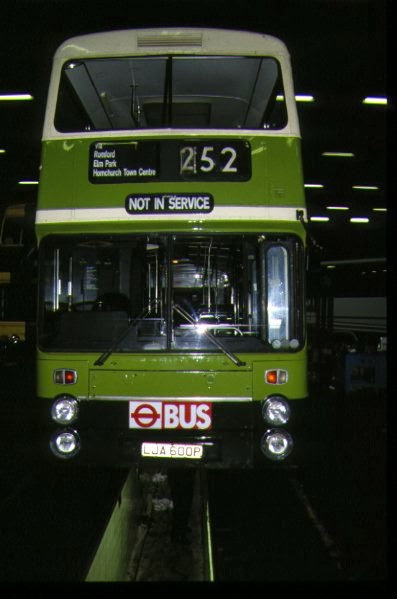
Metrobuses for 165 and 365 and Olympians for the 252
________________________________________________________________

Friday 27th September was the end of an interesting chapter of London’s bus history, and for me personally. 

In 1988, when working at Ensign Bus Services Ltd, I won four bus routes in Romford – 165, 365, 246 and 446. Two other routes, 248 and 252 were won by East Midlands.
What we started with - all secondhand and all beautifully turned out
At the time, it was the biggest private sector win over London Transport ever. Indeed, it caused Hornchurch Garage to close. The realities of competitive tendering were beginning to dawn on the incumbent operator. 

I remember like it was yesterday, working all night to be ready, with our fleet of buses springing into service in September 1988. East Midlands did not fair so well and we took over their routes too, but not before another long night at start up.
Our second long night involved
absorbing these old Manchester
Atlanteans from East Midland

Our cornerstone of Romford routes were repeatedly tendered and retained although operations physically transferred to a new site at Dagenham Dock. Others tried to unseat us from these routes but we endured.

Over time, Ensign Bus Services' ownership changed – an abortive sale to a US company came and went – and we ended up being owned by CNT Holdings in Hong Kong. In the meantime, London Transport’s buses were also privatized and our nearest neighbour became an operating unit called East London which eventually was sold to Stagecoach.

In due course, in 1995, my management team, led by my great friend Brendan Glyde and I, bought the company. Soon after, these routes were again tendered and retained – much to our relief and despite a massive effort by others to beat us. But by 1998, we had much expanded the business and having exhausted the borrowing capacity and patience of our financial backers, we sold it on to FirstGroup plc.

The business was joined with CentreWest London Buses Ltd – Peter Hendy’s former company now also in FirstGroup ownership. Despite contract churn across East and West London these core routes remained steadfastly in Dagenham Dock with us, although a new depot on a nearby site replaced the old one.

As a director of First, I ceased to have direct management responsibility for London operations in 2005 but continued to keep a fatherly eye on those Romford routes.

So here we are, 25 years later, by a quirk of fate it was me, now in my capacity as MD Surface Transport at TfL, who took them away and gave them (back) to East London – now a subsidiary (for the second time) of Stagecoach.

After a quarter of a century they are returning from whence they came to the “London Transport” operator in the area although Hornchurch Garage itself is no more – indeed is a housing estate.

On Friday, I went to Romford for a nostalgic ride around my old network, reminiscing about how I used to drive on these routes especially late at night and at weekends. Much, of course, has changed in Romford since then. When the routes finished on Friday night, it completed First's exit from London and the last real traces of my old company.

To all who made that chapter so enjoyable – employees of Ensignbus, Capital Citybus, and First – thank you and enjoy the memory! 


Top - the old Hornchurch Garage which closed
and
Bottom - Dagenham Dock - an open space with a maintenance
shed and fuel tank in the most exposed and uninhabited
place in England - or so it seemed!


…