Saturday, 28 September 2013

What goes around....

We were very pleased with our new buses when
they came in 1989:

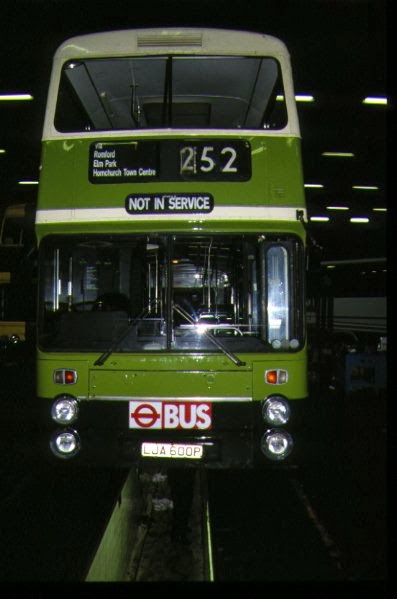
Metrobuses for 165 and 365 and Olympians for the 252
________________________________________________________________

Friday 27th September was the end of an interesting chapter of London’s bus history, and for me personally. 

In 1988, when working at Ensign Bus Services Ltd, I won four bus routes in Romford – 165, 365, 246 and 446. Two other routes, 248 and 252 were won by East Midlands.
What we started with - all secondhand and all beautifully turned out
At the time, it was the biggest private sector win over London Transport ever. Indeed, it caused Hornchurch Garage to close. The realities of competitive tendering were beginning to dawn on the incumbent operator. 

I remember like it was yesterday, working all night to be ready, with our fleet of buses springing into service in September 1988. East Midlands did not fair so well and we took over their routes too, but not before another long night at start up.
Our second long night involved
absorbing these old Manchester
Atlanteans from East Midland

Our cornerstone of Romford routes were repeatedly tendered and retained although operations physically transferred to a new site at Dagenham Dock. Others tried to unseat us from these routes but we endured.

Over time, Ensign Bus Services' ownership changed – an abortive sale to a US company came and went – and we ended up being owned by CNT Holdings in Hong Kong. In the meantime, London Transport’s buses were also privatized and our nearest neighbour became an operating unit called East London which eventually was sold to Stagecoach.

In due course, in 1995, my management team, led by my great friend Brendan Glyde and I, bought the company. Soon after, these routes were again tendered and retained – much to our relief and despite a massive effort by others to beat us. But by 1998, we had much expanded the business and having exhausted the borrowing capacity and patience of our financial backers, we sold it on to FirstGroup plc.

The business was joined with CentreWest London Buses Ltd – Peter Hendy’s former company now also in FirstGroup ownership. Despite contract churn across East and West London these core routes remained steadfastly in Dagenham Dock with us, although a new depot on a nearby site replaced the old one.

As a director of First, I ceased to have direct management responsibility for London operations in 2005 but continued to keep a fatherly eye on those Romford routes.

So here we are, 25 years later, by a quirk of fate it was me, now in my capacity as MD Surface Transport at TfL, who took them away and gave them (back) to East London – now a subsidiary (for the second time) of Stagecoach.

After a quarter of a century they are returning from whence they came to the “London Transport” operator in the area although Hornchurch Garage itself is no more – indeed is a housing estate.

On Friday, I went to Romford for a nostalgic ride around my old network, reminiscing about how I used to drive on these routes especially late at night and at weekends. Much, of course, has changed in Romford since then. When the routes finished on Friday night, it completed First's exit from London and the last real traces of my old company.

To all who made that chapter so enjoyable – employees of Ensignbus, Capital Citybus, and First – thank you and enjoy the memory! 


Top - the old Hornchurch Garage which closed
and
Bottom - Dagenham Dock - an open space with a maintenance
shed and fuel tank in the most exposed and uninhabited
place in England - or so it seemed!


…

Saturday, 21 September 2013

Route 11 conversion started on Friday night

Ready for departure at Liverpool Street Station

The first New Bus for London on route 11 entered service Friday night. LT59 left Liverpool Street Station at 1821 for Victoria.

This is the start of a progressive conversion of the route which will be complete in the next 10 days adding a further 27 or so vehicles to the existing fleet.

Surprised passengers were again delighted to hop on & off, and many tourists were scrambling aboard London's latest icon.


My thanks to George Odlum for this photo
This and more at

http://www.flickr.com/photos/88992756@N06/9841077453/

...

Wednesday, 4 September 2013

Heavy Goods Vehicle safety

Boris Johnson in the cab of our HGV
Today’s long-planned Heavy Goods Vehicle safety event was promoting further steps to try and reduce the risk to cyclists from large lorries. Sadly the event was marred by the death of another cyclist – the seventh this year and the fifth in collision with an HGV. My sympathies go out to the family.

At the ‘Exchanging Places’ event opposite the Houses of Parliament, people were able to sit in the cab of a well-equipped HGV and see first hand the blind spots which lorry drivers must contend with.

Boris Johnson and Transport Minister Stephen Hammond were amongst those to experience this.


To make sure that this is a two-way process, promoting safety, our Police will be on the streets of London at specific locations inviting cyclists to see it from the lorry driver’s point of view and caution those who break the law.

Vulnerable road users (which includes pedestrians), can be in jeopardy if they do not remain vigilant whilst using our roads and footways. 

The Mayor and the Minister announced further measures are to be considered. These include the fitting out of HGVs with appropriate safety features, including side guards, mirrors, Fresnel lenses. Additionally all HGV drivers would undertake training highlighting the risks to vulnerable road users. These features are already contractually required for work on GLA family projects including all London Underground and Crossrail works. Good quality operators have also adopted these measures and we are keen for others to follow suit.

Alongside this event, further up the road, we had a joint enforcement operation with VOSA, Police, Department for Works and Pensions and Her Majesty’s Revenue and Customs. Large vehicles were being inspected to make sure that even the minimum legal standards are being achieved – both in terms of vehicle standards, load security and drivers’ standards.

In a series of random checks, rather shockingly nearly a third of vehicles stopped failed to meet those standards. Out of 59 vehicles, 16 had mechanical defects, two drivers had breached Driver Hours Regulations, and 17 were issued with fixed penalty notices. One vehicle with numerous defects had no valid ‘O’ licence nor did the driver have any entitlement to drive.

Certain types of large vehicles are excluded from the Regulations if they are classified as ‘plant’. Thus one heavily overloaded, four-axle volumetric mixer, which needs no Operator’s Licence, HGV drivers’ licence, or HGV test certificate was not only destroying London’s roads but had a defective tyre as well.

We recognise freight as an important part of London’s traffic. The industry delivers goods, facilitates construction and supplies our needs. Indeed our economy depends on it. However given the unequal fight between such large and heavy vehicles against vulnerable road users - we must make sure that all road users are at least following minimum standards.

…

Monday, 5 August 2013

More New Buses for London


LT24 heading towards the forgotten village of Imber on 3rd August
when it was opened for the day

Deliveries of the New Bus for London continue and as previously announced the next batch will enter service on route 11 on 21st September.

We are now able to announce the next two routes which will be converted by the end of the year, ensuring another 35,000 people a day will be able to enjoy the 'hop on hop off" experience.

On 26th October we will convert route 9 - Hammersmith to Aldwych - operated by London United with a peak vehicle requirement of 22 buses.

Early in December we will convert route 390, operated by Metroline between Notting Hill Gate and Archway with a further 20 vehicles.

Our brand new fleet of revolutionary buses will, by the end of the year, be familiar in Whitehall, Trafalgar Square, Knightsbridge, Piccadilly, Strand and Oxford Street.

The buses have also been busy promoting British technology at home and abroad. After leaving the USA, LT1 journeyed to Bogota after which it will head to the Far East. Another vehicle is already doing similar duties in Europe and a third vehicle is likely to be added to the tour. Wherever they go they attract huge attention and continue to promote Britain and British industry.

LT7 also had its moment of fame last weekend, starring on Top Gear driven expertly by James May in a 9 minute segment. On the roads of Somerset and on the test track the bus was put through its paces - managing a three-point turn and demonstrating its tremendous manoeuvrability.

So whether on screen or on the road, or on a major London street - look out for the New Bus for London!

....

Sunday, 21 July 2013

Tottenham centenary


In August 2011, Tottenham was in the headlines when armed police fatally shot Mark Duggan in Ferry Lane, thus sparking what became a series of riots across suburban London. That night – 7/8th August – the London Fire Brigade reported over 2000 emergency calls.

When an uneasy calm returned, Tottenham showed the physical and social scars of the previous few days.

During the last two years, there have been a number of projects underway making improvements in the area. This included removal of the ‘urban motorway’ – the Tottenham gyratory system, returning the High Road to two way working and significantly improving the important interchange at Tottenham Hale.

So it was with excellent timing that a ‘village’ type cultural event took place in Tottenham on Saturday. At its heart was the celebration of 100 years of bus operations from Tottenham Garage. On the nearby green, the community enjoyed the festivities whilst Arriva organised some interesting vehicles to operate on route 76 – a route which has always been associated with the garage. In fact it only left Tottenham Garage once – in 1998, when Capital Citybus (my old company) took over the route moving it to Northumberland Park. Route 76 returned to Tottenham in 2003.

Routemaster and RT-family buses made ‘guest’ appearances on Saturday on the 76, as did a wartime Guy, but perhaps the most unusual were NS1995 and FRM1 from the London Transport Museum. Separated by only 40 years, they depicted the amazing transformation of the London bus.


We collected the vehicles from Acton depot on Saturday morning and made trouble-free journeys to the start points. The NS carried expertly-made route boards for route 76 whilst the FRM already has destination blinds for this route. 

The FRM operated its journey from the old terminus of Victoria and followed the contemporary route via Blackfriars Bridge and Queen Victoria Street. At Tottenham, it was made ready to recreate its first ever journey in public service –  24th June 1967 on route 34B. Thanks to the efforts of Arriva, I was able to position it in exactly the same spot emerging from the garage, even though this involved ignoring the garage’s one-way working and moving parked cars! 


Brimsdown Power Station – the northern terminus, and indeed the reason for the 34B’s existence – has long since gone (although a small substation remains). We positioned it as close as we could on what is now a modern industrial estate which has replaced it.

Their jobs done for the day, both Museum vehicles headed back to Acton having performed faultlessly despite their grand age.

Congratulations to Arriva for staging this tremendous event and reminding the community how public transport is at its heart – taking people to work, school and shopping every day and providing considerable and sustainable employment in the centre of town.


Photo of RM5 with G351, and my positioning of FRM thanks to Graham Smith
....

Wednesday, 10 July 2013

A lesson from history


Photo: John Gascoigne
When the world sees the Routemaster bus they think London - iconic looks, great design and legendry reliability – “the like of which we will never see again.”

Since then every subsequent bus design is compared – generally unfavourably – a box shape, no relieving aesthetic features, and a heavier, more fuel-hungry vehicle in constant need of engineering attention.

But the early days of the Routemaster were anything but happy ones. Conceived in 1947, seven years were to elapse before the first prototype even appeared on the streets. A further two years before it entered service and after three further years it was withdrawn. Two more (bus) prototypes later joined the fleet. RM2 managed to stay on the road for about two years, and RM3 about 20 months.

In addition three other vehicles – fitted with ‘lorry’ bodies – were used to follow regular buses in service and simulate service operations.

Despite all the trial running, the first major entry into service in 1959 was disastrous when nearly 80 Routemasters replaced trolleybuses at West Ham and Poplar.  On the first day the garages received over 100 road calls from bus crews in trouble. Subsequently the situation remained dire, with design defects and poor manufacturing standards often to blame. Numerous campaigns of modifications were immediately put into place.

A major failure caused 22 of them to be removed from service when a complete steering column fractured and all the others were found to be at risk of the same thing.

In the first two years there were 55 campaigns for mechanical alterations, 24 campaigns for electrical issues and 38 for bodywork.

The District Engineer at the garages recorded that in the 15 months to August 1961 on 142 Routemasters he changed:

518 brake shoe liners
425 gearbox seals
416 front shock absorber rubbers
247 alternator belts
185 radiator fans
138 water pumps
126 rear shock absorbers
101 front shock absorbers
46 radiators

He records a similar list for electrical and body work issues.

The heating and ventilation system was found to be particularly poor and despite efforts over the years it remained a real weakness of the design.

During those awful times there were long gaps in service and frequent breakdowns. Passengers were frequently inconvenienced and the staff increasingly demoralised.

In 1963 – some nine years after the first prototype entered service and despite hundreds of thousands of miles of passenger operation – a major rework campaign started. All of the issues were addressed on over a thousand vehicles and slowly the fleet began to deliver a reasonable level of reliability.

I have not found any definitive record of the costs incurred – paid for by fares and taxes alike. The costs of prototype buses which only clocked up a couple of years’ service each; the cost of major rework campaigns; and the cost of major losses of service in terms of revenue.  Over and above this, the countless London Transport engineers and research staff working full time to resolve the problems.

What is clear is that despite extensive prototype testing, and early experience in operation, a very large number of problems in design, manufacture and maintenance did not come to light till after entry into service.

An expensive and lengthy process in the end delivered to London a bus which became a design classic. It was reliable, cheap to run, loved by passengers, staff and engineers alike. Nearly 60 years later it is still in evidence in London.

That process was extraordinarily slow, and required a huge amount of effort. Imagine if in this modern demanding world, a bus had taken nine years from design to operational reliability!


Friday, 28 June 2013

Fifty years on...


You might have been expecting a New Bus for London story last weekend but there was more than enough on-line for everyone at the time.

Better I thought to reflect on the introduction of the new fleet one week on.

Older readers will know that in the mass conversion programmes of the 1960s and 1970s, overnight changes were normal. More recently we have generally made progressive conversions of new types of bus which has meant that all the usual niggling faults, staff unfamiliarity and other teething troubles went unnoticed.

On 22nd June we launched thirty revolutionary vehicles and it was thanks to the tremendous efforts by Metroline that everything ran as well as it did.

With the new three door/two staircase arrangement, passengers too had to get used to the vehicles meaning that journeys were a bit slower than usual and there were a few gaps. As you might expect, with hardly any miles on the clock, the vehicles too had teething problems but this time – with the Mayor’s personal project in the spotlight – it was headline news.

Suffice to say, one week on the service is improving rapidly, the staff and passengers have got the hang of it all, and the buses are settling down. In fact the faults per vehicle are actually no worse than with any other type of new bus – just far more newsworthy.

Passengers love the new product – they like the Customer Assistants and the ease of speedy boarding. People still stand and stare at the bus as it progresses through Central London. Unseen of course is its tremendous fuel consumption and low emissions.

The last time route 24 was subjected to this type of shock – the introduction of London’s first rear-engined double-deckers on 7th November 1965 – nearly half of the fleet was being given roadside assistance on the first day and the service never really recovered.

But this is 2013. Our new bus is in 24-hour service delivering a promise made by the Mayor and for which the majority of Londoners voted in favour just over a year ago. And there are more to come.....


Top photo in 1960s Pimlico by Mike Beamish
.....