Sunday, 21 July 2013

Tottenham centenary


In August 2011, Tottenham was in the headlines when armed police fatally shot Mark Duggan in Ferry Lane, thus sparking what became a series of riots across suburban London. That night – 7/8th August – the London Fire Brigade reported over 2000 emergency calls.

When an uneasy calm returned, Tottenham showed the physical and social scars of the previous few days.

During the last two years, there have been a number of projects underway making improvements in the area. This included removal of the ‘urban motorway’ – the Tottenham gyratory system, returning the High Road to two way working and significantly improving the important interchange at Tottenham Hale.

So it was with excellent timing that a ‘village’ type cultural event took place in Tottenham on Saturday. At its heart was the celebration of 100 years of bus operations from Tottenham Garage. On the nearby green, the community enjoyed the festivities whilst Arriva organised some interesting vehicles to operate on route 76 – a route which has always been associated with the garage. In fact it only left Tottenham Garage once – in 1998, when Capital Citybus (my old company) took over the route moving it to Northumberland Park. Route 76 returned to Tottenham in 2003.

Routemaster and RT-family buses made ‘guest’ appearances on Saturday on the 76, as did a wartime Guy, but perhaps the most unusual were NS1995 and FRM1 from the London Transport Museum. Separated by only 40 years, they depicted the amazing transformation of the London bus.


We collected the vehicles from Acton depot on Saturday morning and made trouble-free journeys to the start points. The NS carried expertly-made route boards for route 76 whilst the FRM already has destination blinds for this route. 

The FRM operated its journey from the old terminus of Victoria and followed the contemporary route via Blackfriars Bridge and Queen Victoria Street. At Tottenham, it was made ready to recreate its first ever journey in public service –  24th June 1967 on route 34B. Thanks to the efforts of Arriva, I was able to position it in exactly the same spot emerging from the garage, even though this involved ignoring the garage’s one-way working and moving parked cars! 


Brimsdown Power Station – the northern terminus, and indeed the reason for the 34B’s existence – has long since gone (although a small substation remains). We positioned it as close as we could on what is now a modern industrial estate which has replaced it.

Their jobs done for the day, both Museum vehicles headed back to Acton having performed faultlessly despite their grand age.

Congratulations to Arriva for staging this tremendous event and reminding the community how public transport is at its heart – taking people to work, school and shopping every day and providing considerable and sustainable employment in the centre of town.


Photo of RM5 with G351, and my positioning of FRM thanks to Graham Smith
....

Wednesday, 10 July 2013

A lesson from history


Photo: John Gascoigne
When the world sees the Routemaster bus they think London - iconic looks, great design and legendry reliability – “the like of which we will never see again.”

Since then every subsequent bus design is compared – generally unfavourably – a box shape, no relieving aesthetic features, and a heavier, more fuel-hungry vehicle in constant need of engineering attention.

But the early days of the Routemaster were anything but happy ones. Conceived in 1947, seven years were to elapse before the first prototype even appeared on the streets. A further two years before it entered service and after three further years it was withdrawn. Two more (bus) prototypes later joined the fleet. RM2 managed to stay on the road for about two years, and RM3 about 20 months.

In addition three other vehicles – fitted with ‘lorry’ bodies – were used to follow regular buses in service and simulate service operations.

Despite all the trial running, the first major entry into service in 1959 was disastrous when nearly 80 Routemasters replaced trolleybuses at West Ham and Poplar.  On the first day the garages received over 100 road calls from bus crews in trouble. Subsequently the situation remained dire, with design defects and poor manufacturing standards often to blame. Numerous campaigns of modifications were immediately put into place.

A major failure caused 22 of them to be removed from service when a complete steering column fractured and all the others were found to be at risk of the same thing.

In the first two years there were 55 campaigns for mechanical alterations, 24 campaigns for electrical issues and 38 for bodywork.

The District Engineer at the garages recorded that in the 15 months to August 1961 on 142 Routemasters he changed:

518 brake shoe liners
425 gearbox seals
416 front shock absorber rubbers
247 alternator belts
185 radiator fans
138 water pumps
126 rear shock absorbers
101 front shock absorbers
46 radiators

He records a similar list for electrical and body work issues.

The heating and ventilation system was found to be particularly poor and despite efforts over the years it remained a real weakness of the design.

During those awful times there were long gaps in service and frequent breakdowns. Passengers were frequently inconvenienced and the staff increasingly demoralised.

In 1963 – some nine years after the first prototype entered service and despite hundreds of thousands of miles of passenger operation – a major rework campaign started. All of the issues were addressed on over a thousand vehicles and slowly the fleet began to deliver a reasonable level of reliability.

I have not found any definitive record of the costs incurred – paid for by fares and taxes alike. The costs of prototype buses which only clocked up a couple of years’ service each; the cost of major rework campaigns; and the cost of major losses of service in terms of revenue.  Over and above this, the countless London Transport engineers and research staff working full time to resolve the problems.

What is clear is that despite extensive prototype testing, and early experience in operation, a very large number of problems in design, manufacture and maintenance did not come to light till after entry into service.

An expensive and lengthy process in the end delivered to London a bus which became a design classic. It was reliable, cheap to run, loved by passengers, staff and engineers alike. Nearly 60 years later it is still in evidence in London.

That process was extraordinarily slow, and required a huge amount of effort. Imagine if in this modern demanding world, a bus had taken nine years from design to operational reliability!


Friday, 28 June 2013

Fifty years on...


You might have been expecting a New Bus for London story last weekend but there was more than enough on-line for everyone at the time.

Better I thought to reflect on the introduction of the new fleet one week on.

Older readers will know that in the mass conversion programmes of the 1960s and 1970s, overnight changes were normal. More recently we have generally made progressive conversions of new types of bus which has meant that all the usual niggling faults, staff unfamiliarity and other teething troubles went unnoticed.

On 22nd June we launched thirty revolutionary vehicles and it was thanks to the tremendous efforts by Metroline that everything ran as well as it did.

With the new three door/two staircase arrangement, passengers too had to get used to the vehicles meaning that journeys were a bit slower than usual and there were a few gaps. As you might expect, with hardly any miles on the clock, the vehicles too had teething problems but this time – with the Mayor’s personal project in the spotlight – it was headline news.

Suffice to say, one week on the service is improving rapidly, the staff and passengers have got the hang of it all, and the buses are settling down. In fact the faults per vehicle are actually no worse than with any other type of new bus – just far more newsworthy.

Passengers love the new product – they like the Customer Assistants and the ease of speedy boarding. People still stand and stare at the bus as it progresses through Central London. Unseen of course is its tremendous fuel consumption and low emissions.

The last time route 24 was subjected to this type of shock – the introduction of London’s first rear-engined double-deckers on 7th November 1965 – nearly half of the fleet was being given roadside assistance on the first day and the service never really recovered.

But this is 2013. Our new bus is in 24-hour service delivering a promise made by the Mayor and for which the majority of Londoners voted in favour just over a year ago. And there are more to come.....


Top photo in 1960s Pimlico by Mike Beamish
.....

Sunday, 23 June 2013

Longest day

The start of the longest day of the year found me at Victoria Coach Station for the unveiling of the coveted ‘Red Wheel’ of the Transport Trust.

Launched in April 2009, the Trust launched its nationwide programme marking sites of historical interest with Red Wheel plaques. This is a brilliant initiative to commemorate Britain’s rich and globally important transport legacy and its development over time. The Red Wheel programme marks sites of special historic interest with a distinctive plaque.

Victoria Coach Station has served London and the whole of Great Britain since 1932 and it was fitting that it should be awarded a Red Wheel. I was thrilled to be asked to help unveil it with Stuart Wilkinson, Chairman of the Transport Trust.


However before the ceremony itself, a veritable line-up of old coaches arrived at VCS. They stood in a specially cordoned-off area lined up exactly as they would have been in years gone by to the amusement of the many hundreds of ordinary passengers passing through the coach station that morning.


I had a chance to catch up with several of the vehicle owners and other visitors. Former Traffic Commissioner Chris Heaps was in attendance – himself a great enthusiast for transport history in the South West where he is from. It was also very good to catch up with Tom McLachlan, now well into his 80s, Managing Director of Grey-Green Coaches in the days when they only ran coaches. Grey-Green subsequently stopped running coaches, started running buses, and by acquisition morphed into what today we know as Arriva. 

Then it was time to unveil the plaque – Stuart made his speech and I made mine. It was fitting, I remarked, that Victoria Coach Station is recognised with the Red Wheel having been the centre piece of high quality coach operation for over 80 years. 

The work of the Trust helps remind us that the answers to many of our challenges of the present are contained in our history. For example, good customer service wasn’t invented by modern retailers but was common in all walks of life in the 1950s! 

With the plaque unveiled I was delighted to be asked by Colin Billington to drive his Bristol LL6B from 1951 out of the coach station leading the convoy of vehicles on a commemorative run to the south coast. My expectation was that my short drive for a couple or so blocks would not require a gear-change in the five-speed crash box. But my TfL colleagues were all too clever with the traffic lights and I found myself being as careful as possible with the cogs in Colin’s gearbox whilst navigating the Victoria one-way system at the same time.

With both the outside and the innards of the Royal Blue coach more or less intact, I vacated the cab in Vauxhall Bridge Road. I then waved the convoy away on its expedition to the seaside – much like they did in the heyday of coach excursions over half a century ago.

……

Sunday, 16 June 2013

Howard Collins down under


Several hundred of us said farewell to London Underground’s Chief Operating Officer Howard Collins on Thursday night at a private event at the London Transport Museum. Howard is leaving us this week to take up the post of Chief Executive Officer Sydney Trains.

Howard’s career spans some 36 years joining the then London Transport aged 18. He joined the Traffic Administration Training Scheme – one of the best schemes of its day - working on both the bus and rail side before becoming a Trainee Area Manager with spells on the District and Jubilee lines. He contributed considerably to the latter’s often painful extension to Canary Wharf and Stratford just in time for the opening of The Millennium Dome. 

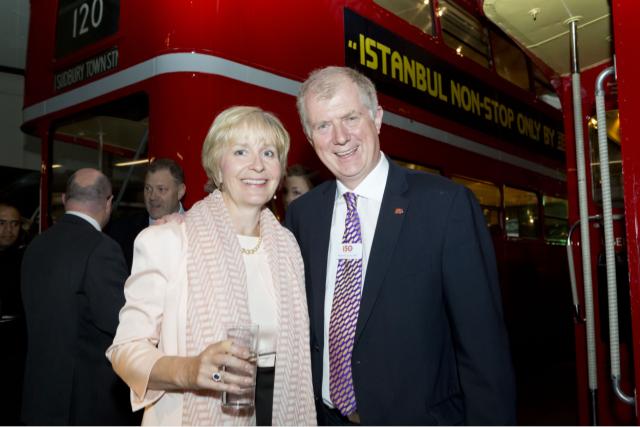
In the past couple of years as Chief Operating Officer he became famous for his appearances on “The Tube” – the documentary series which told the story of behind the scenes on the Underground – indeed his wife (pictured with him above) often said she saw him more on the television than at home. He was inevitably teased about this by his colleagues and every one of the (many) speeches on Thursday evening referred to his high profile media activity. 

Rising to a challenge, it was Howard who decided it actually would be possible to run a real steam train hauling wooden carriages on the Underground to celebrate its 150th anniversary. That event was an incredible success, launching the whole year’s celebrations and bringing with it international attention and acclaim. 

Howard was the lead for London Rail and Underground for the 2012 Olympic Games which rapidly became a full time job. He was deservedly awarded the OBE for his work on this. 

The inevitable round of meetings and reports morphed into the practicalities of the Games themselves and most nights we would find him at Stratford Station, personal megaphone in hand, giving home-going spectators his own subtle brand of encouragement. We are sure there are still some passengers looking for the Jubilee line’s First Class carriages which were (he always said) “at the far end”.

When all the crowds had gone we often walked through the deserted station for our own journeys home and what was often only a short night’s sleep before starting it all over again the next day. 

Howard was one of five of us who shared, in rotation, continuous responsibility for transport - forming the Senior Transport Operator’s Group. As luck would have it, the rota often had him handing over to me which was always comforting as any issues arising on his watch were always resolved and never passed on. All of the agencies involved in the Olympics took great reassurance from his calm and authoritative style – indeed I have never seen him ruffled no matter what the circumstances! 

He was completely absorbed and interested in all the transport being provided for the Games – not just the Underground. He found time to visit most of the venues and talk to everyone working there on transport. There are, in cyberspace, I am sure, thousands of photographs of him with individuals and small groups – TfL staff, others’ staff, volunteers, and of course, everyone who recognized him from “The Tube”…….. 

But having made such a contribution to the best Olympic Games ever what was left for him to do? So it was that the challenge of Sydney Trains became attractive enough for Howard to part company with his only ever employer and uproot his family to just about as far away as you can get. He will use his vast accumulated knowledge, experience and personal style to drive up quality and efficiency in his new home. 

We all wish him huge success in Sydney – fortunately modern communications mean we will hear from him and he will hear from us! And with his ever-attendant sense of timing, he arrives in Sydney just in time to see the closure of that city’s monorail system a few days later……. 


..

Wednesday, 29 May 2013

More New Buses for London


Today we announced that route 11 will be the second bus route in London to be operated by the New Bus for London.

This second route will commence in September. It will be operated by Go Ahead and the vehicles themselves are already in the process of delivery.

In this blog I seek to dispel the rumours which are active cross cyberspace.

The decision making has nothing to do with any of the following: tourism, buses passing Windsor House, cascade consequences, or any such nonsense.

Quite simply, I was keen to allocate the NBfL to two complete routes this year. This means that the routes needed to be at the smaller end of the scale. Sorry to disappoint the fantasists, but the choices and order of conversion are based on practical and economic reasons.

There are, of course, much larger routes in the program but they will wait until 2014 when the delivery rate is faster. The arrival of New Bus for London with its tremendously low emissions will bring air quality advantages to the areas it serves.

Meanwhile LT1 remains in the USA. Tonight it is in Boston and has further destinations in the USA and worldwide as it continues to demonstrate British technology and innovation. There remains considerable interest overseas which may in time translate into export orders for the bus and for its constituent parts.

We are delighted to be rubbing shoulders with other great British innovators and businesses as they seek to sell their wares overseas, and to confirm, of course, that our participation is at no cost to our taxpayers.


...

Saturday, 18 May 2013

New York photos now on this site

I have now been able to upload photographs to the blog so see the two previous instalments!

MTA5261 passes LT1 on W 15th Street New York
Two iconic vehicles in Manhattan